


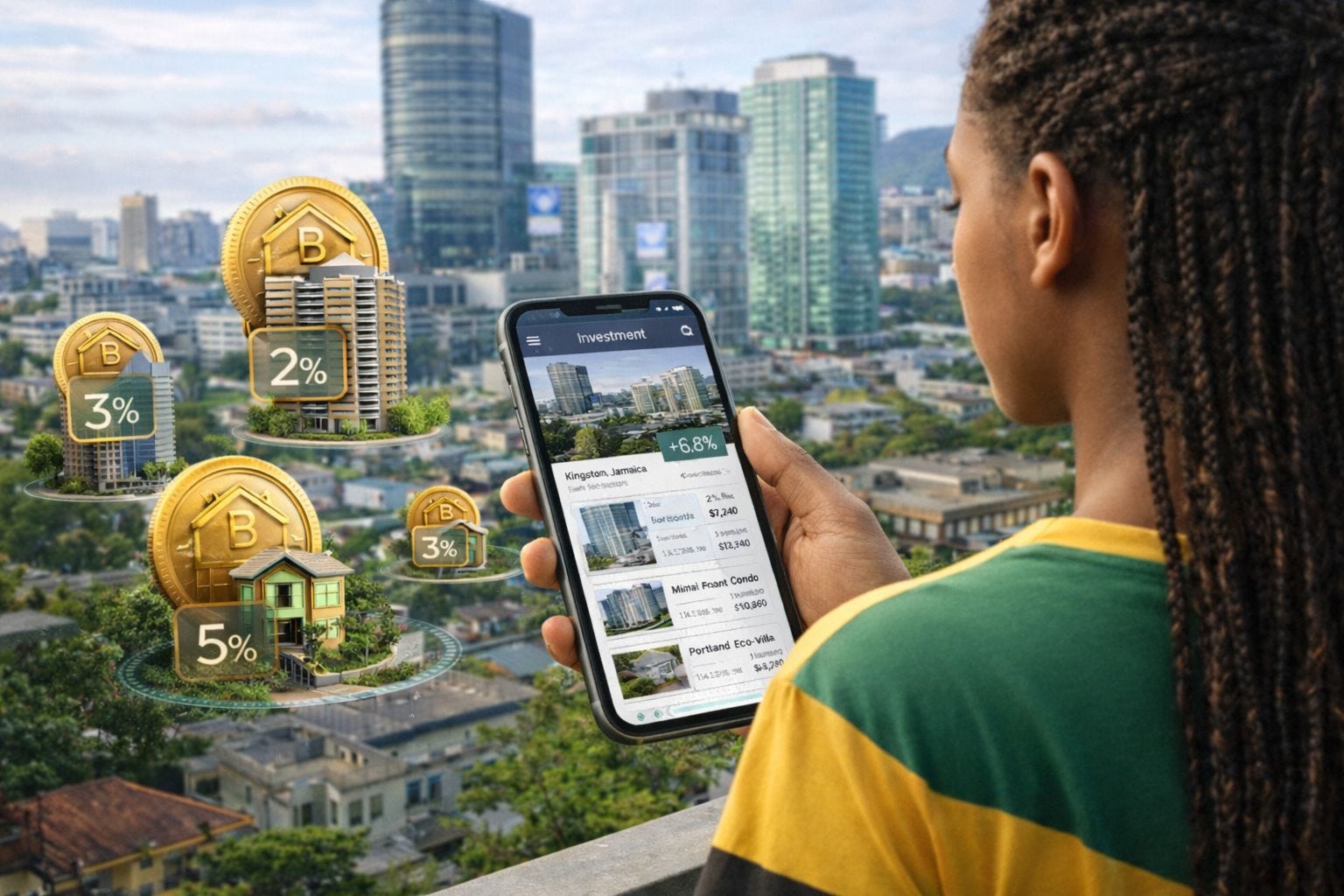
She stands at the edge of elevation, body angled slightly forward, attention fixed on the device in her hand rather than the skyline beyond. The young Jamaican woman occupies a threshold space—neither inside nor fully exposed—mirroring the position she holds within the property market she is assessing. Her clothing is ordinary, familiar, unperformative, anchoring the scene firmly in everyday Jamaican life even as abstract investment symbols hover into view. The Kingston skyline behind her is dense and recognisable, a city shaped by layered growth rather than singular design, now rendered as a field of fractional possibility rather than distant aspiration. Digital markers float calmly in the air, not as spectacle but as quiet indicators of participation: percentages, stakes, portions of buildings once accessible only through inheritance or capital. The architecture reads as stable but transitional, signalling a city being recalibrated rather than replaced. Power here is distributed, no…
