
Jamaica Now

Jamaica Now

Jamaica Homes Glossary

Moore Town

Jamaica Now's avatar
Jamaica Now
Nov 23, 2024
∙ Paid
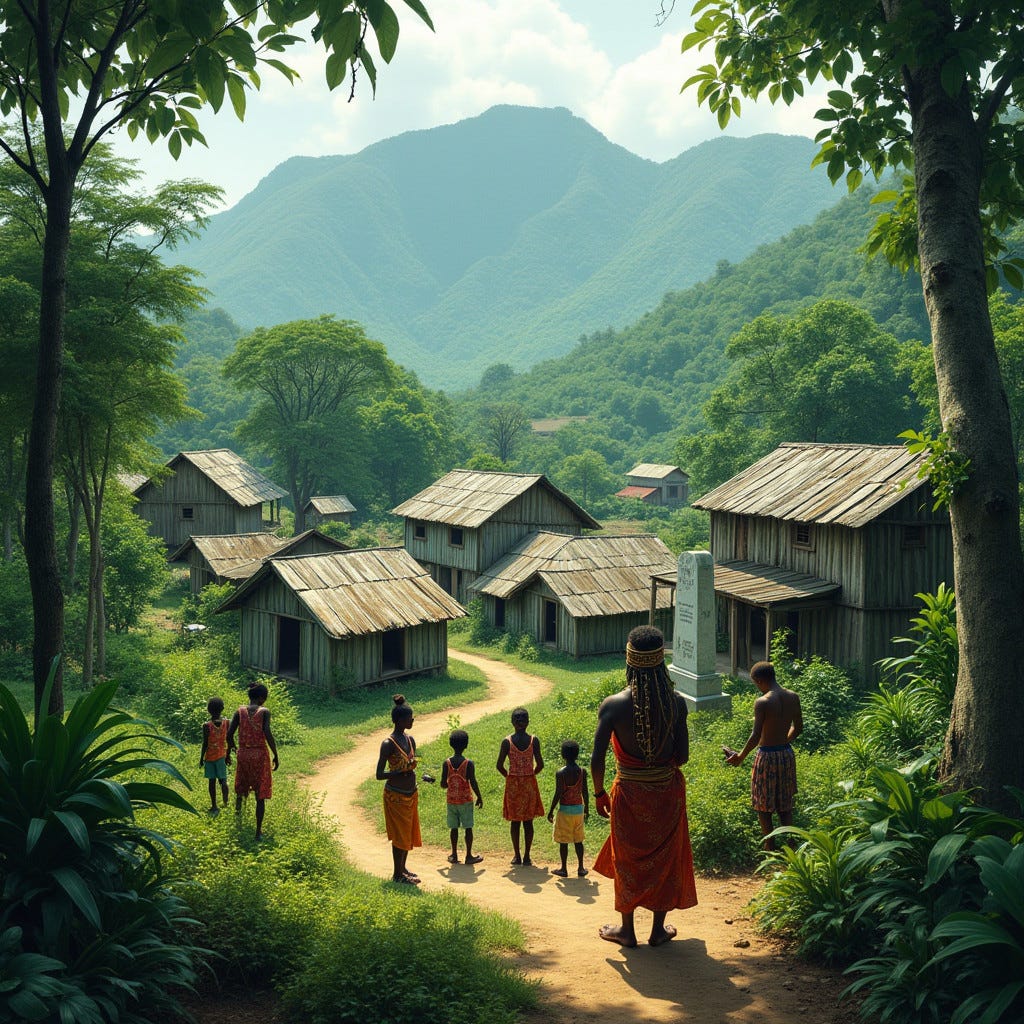
A serene hillside village in Portland, Jamaica, surrounded by dense tropical rainforest with vibrant green foliage, as if painted by the bold brushstrokes of Ivan Aivazovsky, with the vivid colors of Henri Rousseau's jungle scenes. Traditional wooden homes with thatched or tin roofs, reminiscent of Gauguin's Tahitian huts, nestle within the landscape, connected by winding dirt paths that evoke the sense of community found in the works of African-American artist, Jacob Lawrence. In the background, misty mountains rise majestically, their rugged beauty captured in the style of Albert Bierstadt's landscapes. A group of Maroons, dressed in traditional garments with cultural patterns inspired by the textiles of Yinka Shonibare, stands in unity, representing their heritage with strength and resilience. In the foreground, an elder, adorned with African-inspired jewelry, tells stories to children, surrounded by lush greenery, evoking the sense of community and storytelling found in the works of Romare Bearden. A monument or plaque commemorating the 1739 peace treaty between Cudjoe and the British stands proudly, symbolizing freedom and strength. Soft sunlight filters through the trees, casting dappled shadows, as if shot on 35mm film with a cinematic lens, complete with film grain, vignette, and subtle color grading, capturing the essence of a bygone era, with the atmospheric lighting of a Terrence Malick film.

Moore Town, nestled in the lush hills of Portland, stands as a testament to the resilience and ingenuity of the Maroons. Emerging from the peace treaty signed in 1739 between Cudjoe, Nanny’s brother, and the British, Moore Town embodies the hard-won freedom of Jamaica’s Maroon communities. While Cudjoe’s treaty marked the first official recognition of Maroon autonomy, Nanny initially resisted but eventually agreed to a truce. Following this, her followers divided, with one group settling with her brother Quao in Crawford Town and the other following Nanny to establish New Nanny Town, now known as Moore Town.

Integral to the success of Moore Town was the role of the British-appointed white Superintendent, tasked with fostering good relations between the Maroons and colonial authorities. Among the most notable figures to hold this position was Lt. George Fuller, who served as Superintendent between 1809 and 1823. His influence extended beyond administration, as he married a Maroon woman,…

User's avatar

Continue reading this post for free, courtesy of Jamaica Now.

Or purchase a paid subscription.
© 2026 Jamaica Homes · Privacy ∙ Terms ∙ Collection notice
Start your SubstackGet the app
Substack is the home for great culture