


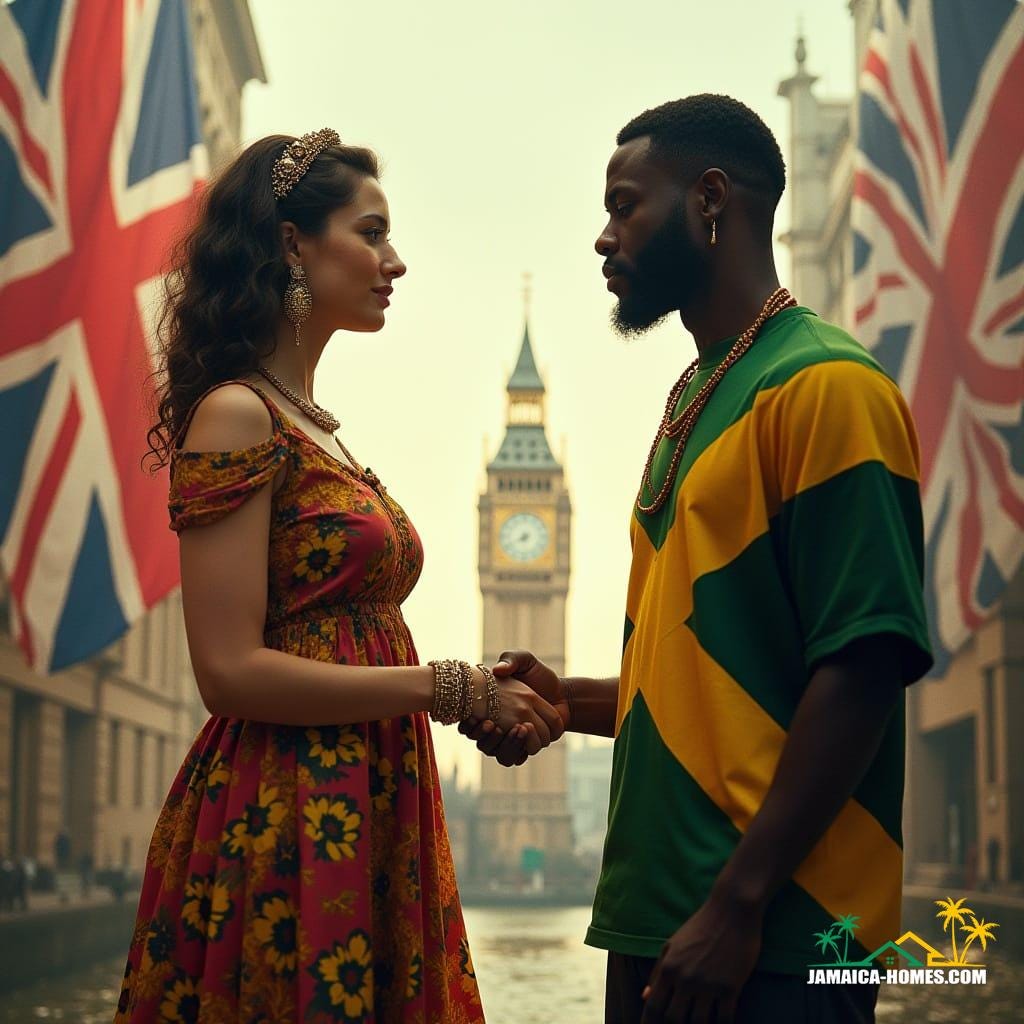
A Jamaican man stands squarely within the frame, his posture assured, his dress unmistakably national, green and gold carried without performance. Opposite him is an English woman, styled with ceremonial restraint, her bearing formal, almost regnal, as if shaped by inherited codes of public presence. Their hands meet at the centre, not as greeting but as agreement, measured and intentional. Behind them, British civic architecture asserts order and continuity, flags lining the street, the clock tower marking authority, time, and governance. The scale of the setting places the exchange within systems larger than either individual, yet neither figure yields ground. The moment recalls long-standing movement between Jamaica and Britain, the memory of Windrush, settlement, return, and negotiation carried quietly in posture rather than words. This is not reconciliation or spectacle, but recognition between histories still in dialogue. The city watches, unchanged, as terms are acknowledged.
Ye…
