



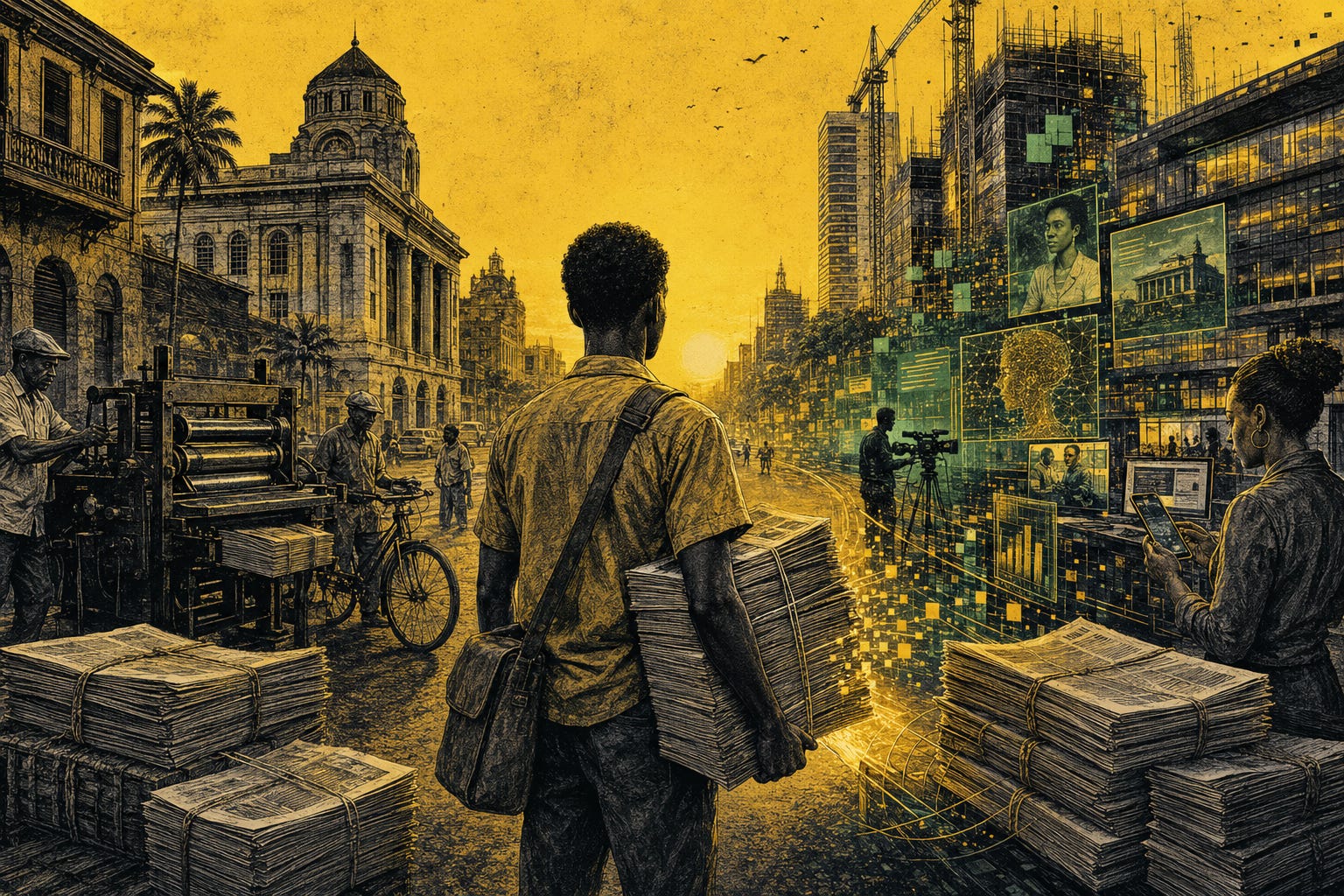
For 192 years, a copy of The Gleaner has come off a press in Kingston. It survived the 1907 earthquake that flattened much of the city around it, a 1882 fire that destroyed its original Harbour Street home, Hurricane Gilbert in 1988, the birth of television, and the birth of the internet. This year, for the first time, the building most associated with that survival — the North Street offices the company has occupied for decades — is being sold to a fabric importer. The paper itself isn’t going anywhere. But the sale is as good a marker as any of how much has changed beneath a brand that, for most of its life, Jamaicans simply called “the newspaper.”
Much of the company’s earlier history remains worth retelling: The Gleaner’s founding by brothers Joshua and Jacob de Cordova in 1834; its three decades as Jamaica’s only unbroken print voice after Independence; its advocacy for private capital and its running battle with Michael Manley’s Democratic Socialist government in the 1970s, a confrontation many credit with helping tip the 1980 election to Edward Seaga; and Oliver Clarke’s 1978 debenture float, which pulled the company back from the brink of financial collapse and cemented its independence.
What has changed is almost everything about the business built on top of that history.
From newspaper company to communications group
The single biggest recent structural change is the 2015–2016 merger of The Gleaner Company with the Radio Jamaica Group, forming the RJRGLEANER Communications Group. The deal was struck by Clarke and the late Radio Jamaica chairman J. Lester Spaulding, who argued that unfavourable local economic conditions made amalgamation necessary for both companies to remain viable, Jamaican-owned news operations. Where The Gleaner once stood alone as a print house with a radio subsidiary, it is now one brand within a group that spans television, radio, and print: Television Jamaica (TVJ), RJR 94FM, The Star, Power 106FM, FAME 95FM, HITZ 92FM, Music 99FM, 1spotmedia, Real Jamaican Television, Jamaica News Network, and TVJ Sports Network, alongside The Gleaner itself.
Oliver Clarke, the man synonymous with the company for four decades, died in May 2020 at age 75 after a battle with cancer, having stepped down as chairman of the RJRGLEANER Group only months earlier to make way for Joseph M. Matalon. Matalon has since led the group through a period of aggressive restructuring rather than expansion. In early 2026, the Supreme Court sanctioned a scheme of arrangement folding several subsidiaries — Multimedia Jamaica, Independent Radio Company, Gleaner Online, Reggae Entertainment Television, and Jamaica News Network — directly into Radio Jamaica Limited, eliminating duplicated corporate structures across the group’s platforms. Matalon framed it plainly: bold, decisive steps were needed, and if the numbers pointed to divesting parts of the business, the group would do so.
That divestment logic reached the company’s most symbolic asset this year. In May 2026, RJRGLEANER announced a binding agreement to sell the historic Gleaner building at 7 North Street, Kingston, to LP Azar Limited — the same site the company has occupied for decades, with operations consolidating instead at the group’s Lyndhurst Road campus. The company described it, in characteristic corporate language, as part of “broader strategic restructuring and modernization initiatives aimed at optimizing its operational footprint.” Whatever the phrasing, it marks the end of a physical chapter: the address that was once shorthand for Jamaican news is now a fabric company’s property.
Financially, the group has grown even as it consolidates. RJRGLEANER reported total group revenues of J$5.31 billion for the fiscal year ended March 31, 2025, drawn from advertising, newspaper sales and subscriptions, broadcast airtime, and digital media services. The Gleaner masthead itself still publishes daily in print, ePaper, and web formats, with the Sunday Gleaner — launched in 1939 — remaining its best-read edition.
A rival that outlasted the merger logic
The competitive pressure that forced The Gleaner’s hand in the 1990s is still very much present. The Jamaica Observer, launched in 1993 by hotelier Gordon “Butch” Stewart as a direct challenge to Gleaner dominance, remains an active daily competitor. Following Stewart’s death in January 2021, ownership passed fully to the Stewart family, who continue to run it through Jamaica Observer Limited alongside the broader ATL Group. Unlike The Gleaner, the Observer never merged with a broadcaster, but it has built out its own multi-platform digital presence and remains the paper most often mentioned in the same breath as The Gleaner in Jamaican media conversation.
The AI disruption
If the 1990s test for The Gleaner was a homegrown print rival, and the 2000s test was the internet, the current test is generative AI, and it is a global one, not a Jamaican one, which makes it harder for any single newsroom to out-manoeuvre.
Two forces are colliding. On one side, AI tools have become standard newsroom equipment: a 2026 survey of nearly 900 working journalists found 82 percent already use AI tools regularly, with ChatGPT the most common choice, spanning everyone from beat reporters to foreign correspondents. Used well, that speeds up routine work — earnings summaries, data journalism, transcription — freeing reporters for the harder, human parts of the job. On the other side, the same technology is supercharging the problem newspapers exist to solve: one detection firm logged 3,165 deepfake incidents in a single month in early 2026, compared with just four in all of January 2020. AI-generated video, cloned voices, and fabricated news broadcasts are now something any newsroom, anywhere, has to be ready to debunk on short notice, often about itself.
There’s also a quieter, more structural threat: AI chat tools and “answer engines” increasingly summarize news for readers directly, cutting out the click to the original publisher altogether — a dynamic squeezing digital ad and subscription revenue across the industry, The Gleaner and Observer included.
Jamaica’s own regulators have started treating this as a public literacy problem rather than purely a newsroom one. A late-2025 University of the West Indies study surveying over a thousand Jamaicans across all fourteen parishes fed into a May 2026 panel discussion where Broadcasting Commission of Jamaica executive director Cordel Green argued that growing digitisation leaves the public newly vulnerable to misinformation, making digital literacy essential. That framing — protecting the audience’s ability to tell real reporting from synthetic content — is arguably the modern version of the role this article’s original telling gave The Gleaner in the 1970s: shaping what the public could trust as true.