



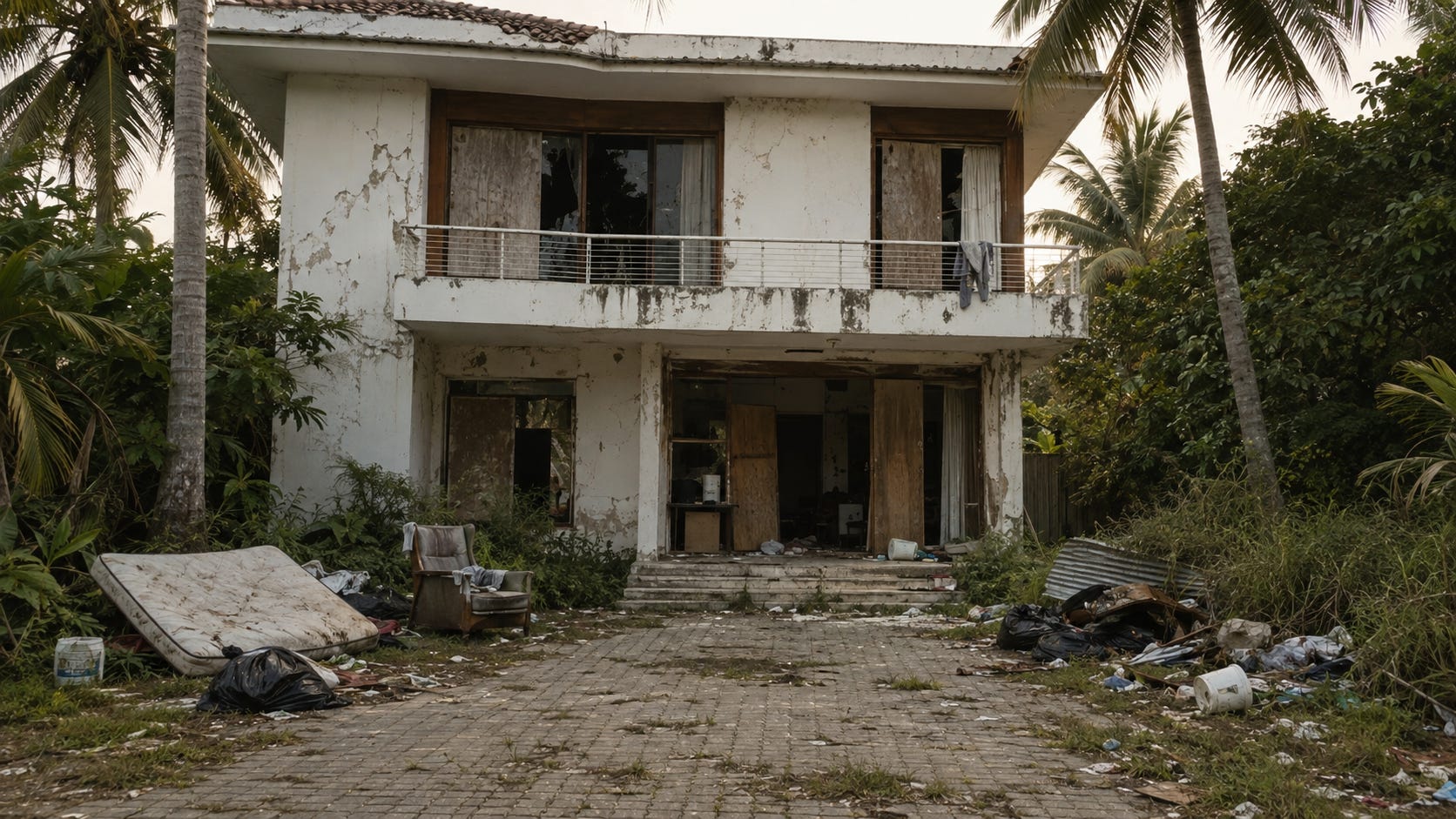
The house took thirty years to build.
Not thirty years of construction. Thirty years of night shifts, cold mornings abroad, missed Christmases and money sent home in careful pieces. First came the land. Then the foundation, walls and windows. Tiles travelled in barrels. Every room contained a sacrifice.
This was not a speculative investment. It was the place where its owner intended to grow old.
Then somebody moved into the unfinished building next door.
There was no electricity, running water or proper bathroom. Washing and toileting took place outside. From the veranda of a home representing hundreds of thousands of pounds in lifetime investment, the owner watched conditions no planned community should be expected to absorb.
Calls were made. Concerns were raised. Nothing moved with the urgency of the person who had moved in.
That is how squatting becomes permanent in Jamaica. Not always through one dramatic act, but through silence, delay and the dangerous national habit of waiting until a problem is too large to ignore.
When Absence Is Mistaken for Abandonment
The Government has announced that it will develop a programme to formalise and regularise irregularly settled communities while preventing further squatting. The announcement followed the demolition of homes at Coopers Pen in Trelawny and the distressing displacement of families living there.
Those families deserve humanity. People should not be reduced to rubble, headlines or political ammunition. Jamaica’s shortage of affordable housing is real, and many people living in informal communities are workers and parents who have been locked out of the formal housing market.
But compassion cannot mean pretending there is no victim on the other side of unlawful occupation.
The land may belong to a pensioner. The unfinished house may represent a family’s entire retirement fund. A Jamaican does not surrender ownership by boarding a plane or postponing construction.
Absence is not abandonment.
For many returnees, distance creates vulnerability. A house stands empty while its owner works abroad. Grass rises. A window breaks. Someone enters. By the time the owner discovers it, removal may be slow, costly and confrontational.
“Jamaica cannot invite the diaspora to invest with one hand while allowing their property rights to become uncertain with the other,” Dean Jones, founder of Jamaica Homes, said. “A title must mean something whether the owner is in Kingston, London, Toronto or New York.”
The Quiet Destruction of a Neighbourhood
Squatting is often discussed as though its effects stop at the boundary being occupied. They do not.
Where buildings lack water, sewage, waste collection or safe electrical connections, surrounding residents can inherit the consequences. Where land is left unmanaged, rubbish accumulates, animals gather and the property becomes a source of conflict. Where intimidation is reported, neighbours may become afraid to complain. One unlawfully occupied building can alter how an entire street feels.
Property values may suffer, but value is more than a figure on an appraisal. It is sitting outside without being watched, welcoming children without anxiety and sleeping without wondering who may enter the derelict building next door.
There are accounts of residents being threatened after challenging unlawful occupation. Such reports require investigation, not exaggeration, and do not prove that every informal settler is dangerous. Poverty is not criminality.
But neither poverty nor housing need can become a shield behind which threats, trespass, vandalism or violence are ignored. A land dispute does not cancel the criminal law, and official intervention should not begin only after someone is injured.
A Country Waiting for the Crisis
Jamaica has been here before.
A 2008 assessment referenced by UN Habitat identified more than 750 squatter settlements and estimated that approximately 600,000 Jamaicans were living in them at the time. The figures are now nearly two decades old, which raises an obvious and uncomfortable question: does the country even know the present scale of the problem?
Government cannot manage what it has not recently mapped. Nor can it protect families and owners while every case remains trapped among land offices, municipal authorities, social services, the police and the courts.
The result is government by crisis. An informal structure appears and is ignored. More follow. Political intervention arrives only when demolition photographs spread across social media or a dispute becomes violent. By then, every available decision carries human pain.
That is not policy. It is postponement wearing a government badge.
Regularisation Cannot Become a Reward for Taking Land
The proposed programme must make a clear distinction between long established communities and recent occupation of individual properties.
Some communities may be suitable for regularisation, with planned roads, drainage, sanitation, utilities and a lawful route to tenure. Others may sit on floodplains, unstable slopes, road reserves or land required for public infrastructure. In those cases, humane relocation may be unavoidable.
Private property presents a different question. The State cannot create a system in which citizens who saved, searched, paid and followed the law are placed behind those who occupied first. Regularisation must not become a message that the quickest route to land is to take it and wait for politics to catch up.
There must be a rapid response to new occupation, a single reporting route for owners and clear responsibilities across public agencies. Social services should assess genuine vulnerability. Land agencies should verify ownership. Municipal authorities should address sanitation and unsafe structures. The police should respond to credible reports of threats, violence, theft and damage. Courts must be accessible before a conflict becomes explosive.
Neglected property must also be confronted. Neglect never transfers ownership, but overseas owners should arrange inspections, secure unfinished buildings, maintain boundaries, keep records current and appoint trustworthy local professionals.
Owning from abroad cannot mean forgetting from abroad.
The Question Every Returnee Should Ask
For decades, Jamaicans overseas have been encouraged to come home, buy land, build houses, create businesses and invest in the country’s future. Their money is welcomed immediately. Their protection cannot arrive eventually.
“This is bigger than one squatter or one returnee,” Jones said. “It is about whether Jamaica can protect human dignity and lawful ownership at the same time. A serious country must be capable of both.”
That is the real test of the Government’s announcement.
Not whether another programme receives a name. Not whether another committee is formed. Not whether another speech is delivered after another community is demolished.
The test is whether a vulnerable family can receive housing support without another family losing the land for which it sacrificed. Whether a returnee can build without wondering who will occupy the house before retirement arrives. Whether neighbours can report dangerous conditions before fear takes control of the street. Whether lawful ownership remains lawful in practice, not only on paper.
The house at the centre of this story took thirty years to build.
It should not take Jamaica another thirty years to decide that the dream is worth protecting.